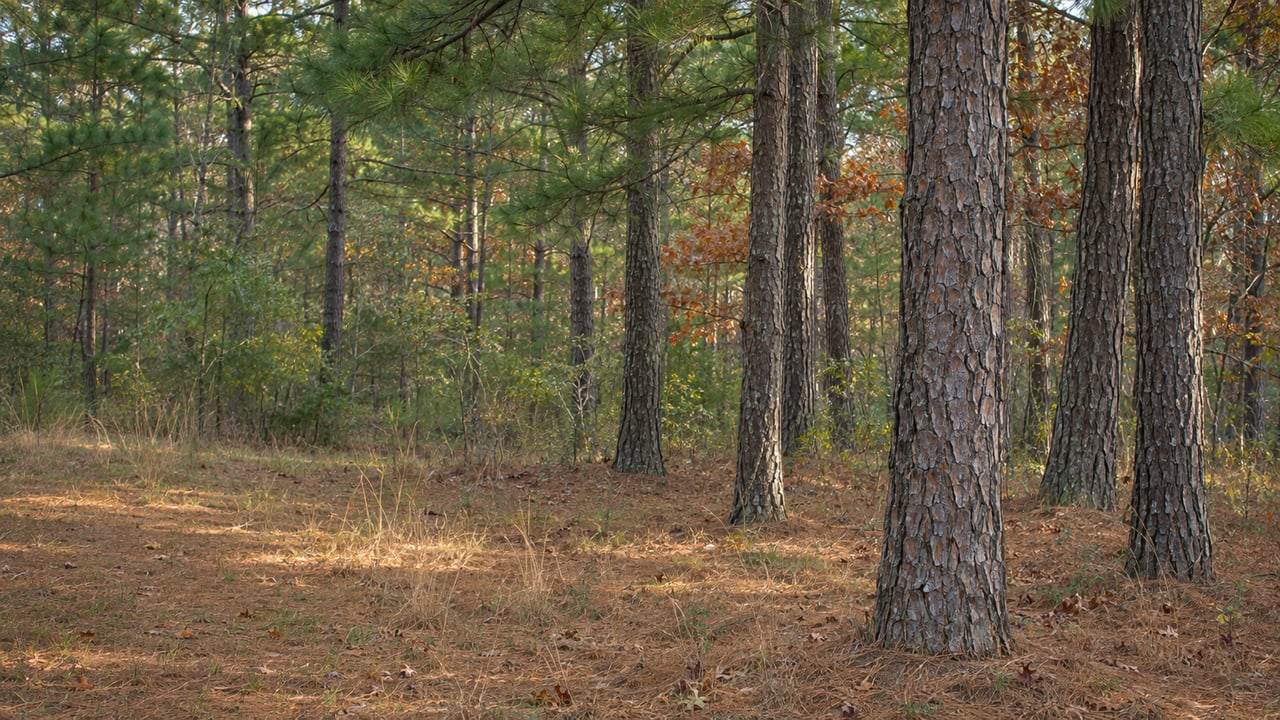
Picture two pine tracts outside Washington with the same acreage, the same road frontage and similar asking prices. On one, the pines are big enough for sawlogs. On the other, the stand is young and thin enough that most of its wood would go to pulpwood. In the third quarter of 2026, TimberMart-South's South-wide average put pine sawtimber stumpage at $23.88 a ton and pine pulpwood at $5.18 a ton. At those prices, a ton from the first tract is worth about four and a half times a ton from the second, and the gap has been growing.
In Wilkes County this year, two things widened that gap. A yellow-pine sawmill reopened on Harris Road, and the market for small pine kept losing buyers across the region. If you are comparing timber or recreational tracts around Washington, how much of the stand is sawtimber, and how far that wood has to travel to a mill, now tell you more about a tract's value than its acreage does.
The mill on Harris Road
WRDW reported in May 2026 that the former International Paper site on Harris Road had reopened as Wilkes Lumber, a chip and sawmill on 80 acres. Its owner is Wilkes Barnett, a lifelong Washington resident, and its director of operations is Mack Winfrey. The station reported that the mill had been producing finished untreated lumber since April 1. The Georgia Forestry Commission's wood-using industries directory lists Wilkes Lumber at 371 Harris Road as a softwood sawmill that takes yellow pine and makes rough, planed and kiln-dried lumber. TimberMart-South's second-quarter 2026 bulletin noted that the mill reopened in early April after a 25-year closure.
The mill's history explains this year's market. In a second WRDW story, Winfrey said the original mill, once the largest east of the Mississippi in the 1990s, shut down because getting rid of its wood chips became too costly and difficult. Paper mills had long bought those chips, and they bought fewer as print gave way to digital. The same weak demand for chips and small wood is what separates the two tracts above. The tract with sawlog-size pine has a buyer in town again. The tract with mostly small pine depends on the paper and pulp market that closed the mill the first time.
Winfrey described the reopening to WRDW in terms of distance. "They don't have to take them 150 miles," he said of local timber growers. "They can bring a 40 mile, 50 mile haul." He estimated the mill would eventually employ 60 to 65 people, up from about 50 in its first phase, and said its lumber would go to big-box stores such as Home Depot and Lowe's for home construction. The station reported that the reopening followed a hard stretch for local growers, who had been hit by mill closures, damage from Hurricane Helene and wildfires. Wilkes Lumber is not the only yellow-pine sawmill in town. The Forestry Commission directory also lists Burt Lumber in Washington, which makes treated, planed and kiln-dried lumber.
Why small pine keeps losing value
Pulpwood's slide began well before 2026 and has not reversed. According to Southern Ag Today's October 26, 2026 market update, the South-wide pine pulpwood price fell for the seventh straight quarter in Q3 2026, averaging just over $5 a ton. That was 16% lower than a year earlier and less than half its 2022 high. In Georgia, the state's Forestry Task Force report measured the statewide average pine pulpwood stumpage price as more than 44% below its peak of over $13.50 a ton in the fourth quarter of 2022.
Those declines followed closures of facilities that bought small wood. In 2025, International Paper shut containerboard mills in Savannah and Riceboro, according to Packaging Dive. Georgia-Pacific closed its Cedar Springs containerboard mill on August 1, 2025. The task force grouped these as four major mill closures that together removed about 8.3 million tons of annual timber demand, including 4.5 million tons from Georgia. Across the South, Southern Ag Today counted more than 10 major pulp facility closures between 2023 and 2025, eliminating over 25 million tons of annual fiber demand.
Sawmills felt the pressure too. On November 6, 2025, West Fraser announced plans to permanently close its Augusta lumber mill by the end of 2025. The company cited weak lumber demand and the loss of economically viable outlets for residuals, which are the chips and other byproducts a sawmill has to sell. The announcement covered about 130 jobs and 140 million board feet of annual capacity. The problem that closed the original Washington mill appears again, more than two decades later, in a large corporate press release.
Northern Georgia sawtimber went the other way
In this setting, the latest regional sawtimber number stands out. Southern Ag Today reported that South-wide pine sawtimber averaged just under $24 a ton in Q3 2026, down 5% year over year and 14% below its early-2022 peak. In northern Georgia, pine sawtimber stumpage rose 13% over the same twelve months, one of the largest gains in the South. Over that period, eastern Tennessee fell 23% and North Carolina fell 11%.
The most recent northern Georgia dollar figures come from the University of Georgia's 2026 timber forecast, which covers Q3 2025: pine sawtimber around $22 a ton, chip-n-saw just over $17 and pulpwood slightly over $6. Those numbers are more than a year old, and the 13% gain came after them, so treat them as a starting point rather than a quote for today. Two things are clear from the Q3 2026 data. Sawtimber is the one pine product whose northern Georgia price rose over the past year, and pulpwood is the one that keeps falling almost everywhere.
Chip-n-saw falls between the two on price. The Q3 2026 South-wide average was $16.78 a ton, down $1.42 from a year earlier. On a tract around Washington, how a stand divides among these three product classes affects its timber value more than anything else.
How to read a tract with this in mind
When you look at a Wilkes County pine tract this winter, start with the size class of the trees, not the acreage. If the stand is mostly sawtimber, the tract's timber is priced in the product with the firmest regional trend and an in-town yellow-pine buyer. If the stand is mostly pulpwood, its timber is priced in a product that has fallen for seven straight quarters, and much of the tract's value has to come from the land itself.
Haul distance belongs in the same calculation. When Winfrey compares a 40-to-50-mile haul with a 150-mile one, he is describing the cost of trucking that comes out of what a logger can pay for standing timber. A tract a short drive from Harris Road and a tract on the far side of the county may have the same stumpage price on paper and still bring different offers.
Waiting does not automatically help either kind of stand. Southern Ag Today cautioned that landowners who have put off harvesting may need to reset their expectations, because prices may not return to the levels above $40 a ton seen before the 2008–2009 financial crisis. It added that trees left too long can grow beyond some sawmills' preferred sizes and bring lower stumpage. For pulpwood-heavy land in areas hit by mill closures, the same update suggested owners may adjust their long-term plans by reducing planting density when they replant or by delaying thinning. A late-summer 2026 consulting forestry newsletter covering west-central Georgia noted a risk on the other side of that choice. Putting off a thinning in an overstocked pine stand can raise the risk of beetle damage, so whether to harvest or wait depends on the stand and on the owner's goals.
A timber cruise is the usual way to measure that split, and our earlier guide to timber cruises for Georgia land buyers covers what one involves. The stumpage figures here are regional averages for general information. They are not a valuation of any tract or financial advice, so confirm the numbers for a specific stand with a consulting forester before you price an offer.
Questions we hear about Washington-area timber
Can I multiply a tract's tonnage by the South-wide averages? Only for a rough first look. TimberMart-South's Q3 2026 figures average the whole South. Prices that quarter ranged from $16 to $19 a ton for pine sawtimber in eastern Tennessee and Virginia to more than $30 in Florida and western North Carolina, according to Southern Ag Today. Offers on a Wilkes County stand depend on local mills, haul distance and the stand's mix of products.
Does the reopened mill help a hardwood-heavy tract? The Forestry Commission directory lists Wilkes Lumber as a softwood sawmill taking yellow pine. Southern Ag Today reported that South-wide hardwood pulpwood fell more than 24% after early 2026, to slightly above $6 a ton in Q3 2026. A hardwood stand's value depends on hardwood buyers, which are a separate market from the one this post covers.
Is the northern Georgia sawtimber gain likely to last? Southern Ag Today linked weak pine sawtimber prices to a slow housing market. Single-family housing starts were at a seasonally adjusted annual rate of 859,000 units in September 2026, below the 1.1 million benchmark associated with a healthy economy. The 13% gain covers one year in one subregion, so treat it as a trend to watch rather than a price to count on.
If you own pine near Washington or are weighing a tract in Wilkes County, we can help you understand what the stand is made of and how this year's mill changes affect it before you set a price or make an offer. The Hendrix Group pairs land and forestry experience with local market knowledge from Washington to Lake Country. Schedule a free consultation and bring your cruise data or your questions.