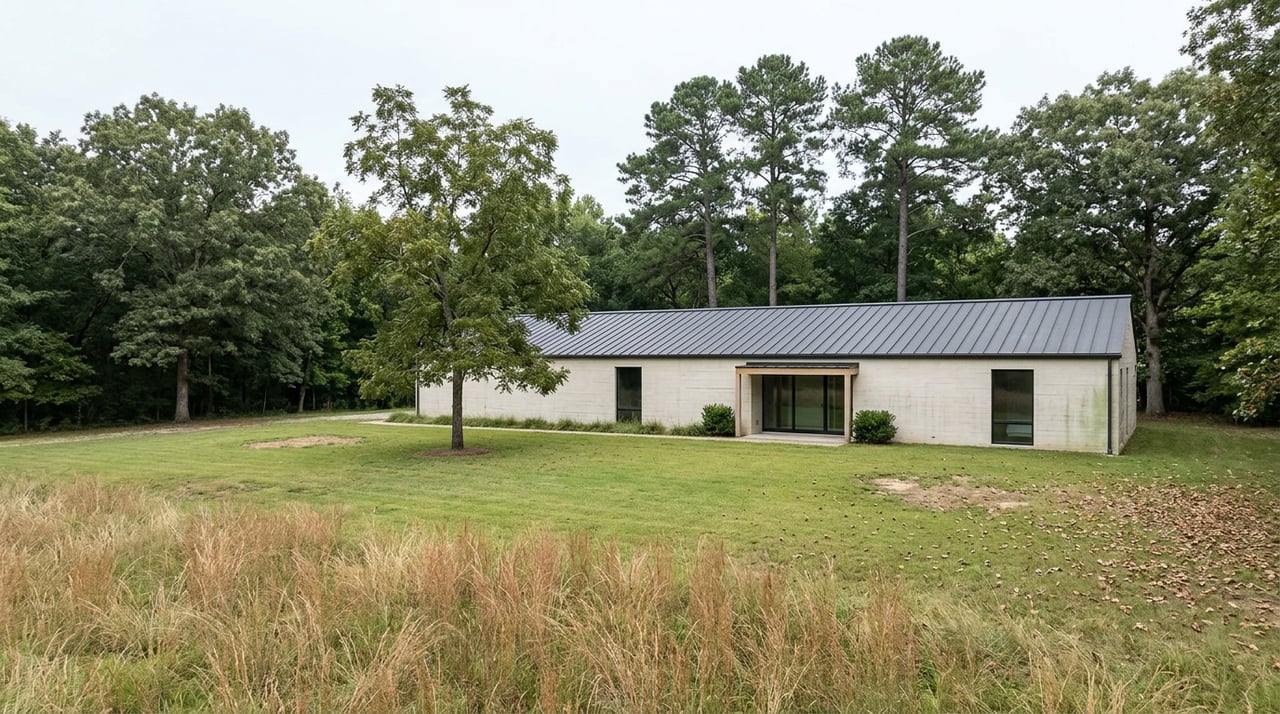
A buyer called us last spring holding a headline in one hand and a listing in the other. The headline said the Lake Oconee market had cooled, prices down double digits from the year before. The listing was twenty-three acres on Flat Rock Church Road in White Plains, priced at $675,000. He wanted to know if he should offer less, because the market was supposedly falling.
He was reading the wrong number. The stat he'd seen described the 30642 zip code, which is Greensboro and most of Reynolds Lake Oconee, a market built around clubhouse memberships and deepwater docks. The tract he was standing on had never been part of that market. It never will be, and that's exactly why it was priced the way it was.
This is the confusion we see most often from people shopping Greene County acreage. There is no single Lake Oconee market. There are at least two, stitched together under one countywide median that tells you almost nothing useful about either.
One Number, Two Markets
Here's what the aggregate hides. In the 30642 zip code, the median sale price sat near $728,000 as of May 2026, down about 17 percent year over year, with homes taking roughly 114 days to go pending. Read on its own, that sounds like a market handing buyers leverage.
It isn't, or at least not for the reason it appears. That decline lines up with a wave of new inventory hitting the shoreline corridor at a lower price point than the trophy waterfront estates that used to anchor the median. Park Place Phase 2 came back to the Greene County Board of Commissioners on April 14, 2026 with a revised preliminary plat. Airabella, a 137-acre mixed-use project near Greensboro, has its first phase of twenty-one townhomes under construction. Richland Pointe is bringing cottage-scale lots to the eastern shore. None of that is a price cut. It's a mix shift, cheaper product entering a market that used to be dominated by $2 million and up waterfront homes, pulling the median down without any single property losing value.
White Plains land was never part of that calculation to begin with. It sits outside the club-driven shoreline economy entirely, which means its pricing runs on a different logic and moves on a different clock.
What an Acre in White Plains Actually Runs
Strip out the shoreline noise and look at raw land pricing across Greene County right now, and the gap is stark.
| Market | Average price per acre |
|---|---|
| White Plains (general land) | $46,682 |
| Greene County overall | $78,134 |
| White Plains farmland specifically | $103,560 |
White Plains land runs roughly 40 percent below the county average. That's not a discount because the land is worse. It's a discount because the county average is dragged upward by parcels inside or adjacent to the resort corridor, where per-acre pricing reflects golf frontage, deepwater access, and club eligibility that a Flat Rock Church Road tract simply doesn't carry and was never marketed to carry.
For a buyer whose interest is acreage itself, timber, hunting ground, a homesite with room to spread out, that 40 percent gap is the whole story. You are not buying a lesser version of Lake Oconee. You are buying into a market that was priced correctly for what it is, while the county number you saw quoted somewhere else was priced for a different product entirely.
The Farm Number That Doesn't Fit
Look again at that table and one line should bother you. Farmland in White Plains prices out at $103,560 per acre, well above both the general White Plains figure and the countywide average. That looks like a contradiction until you notice the sample size behind it: four farms currently listed near White Plains. Four properties do not describe a market. They describe four sellers, four sets of improvements, four decisions about what to ask.
This is worth flagging because it's the kind of number that gets quoted at face value in a casual conversation and then repeated as if it settles something. When someone tells you what farmland "runs" in a small Georgia town, ask how many properties that average is built on. A four-property average can swing wildly on one seller's decision to price a cleared, fenced, improved tract differently than a raw timber stand next door.
Different Tracts, Different Stories
The spread inside White Plains itself makes the same point from another angle. A 0.85-acre parcel on Jordans Mill Road lists at $475,000, priced like a residential building lot because that's what it is. A 31-acre tract on White Oak runs $579,263. A 6.06-acre lot inside the gated Oconee Landing community, built around a shared pond with lake access, private day docks, and a boat ramp, lists at $240,000, a number that reflects the amenity package as much as the dirt underneath it. At the other end, a 176-acre tract on Crawfordville Road lists at $2,000,000, recreational-scale acreage priced for hunting, timber, or a long-term hold rather than a homesite.
Averaging these into one per-acre figure is useful for a headline and almost useless for a decision. A 25-acre tract just outside the White Plains city limits, minutes from Greensboro, has been marketed by a regional land brokerage as suited for hunting, timber management, and recreation in one piece of ground. That's a different buyer and a different math than the Jordans Mill Road homesite or the Oconee Landing pond lot, even though all three sit inside the same small town. It rewards knowing what a specific parcel is for, not what the countywide average says land costs.
The Cost the Sale Price Doesn't Show
Go back to the shoreline side for a moment, because it explains why comparing the two markets directly is a mistake in the other direction too.
Reynolds Lake Oconee operates as a non-equity club, and buying a home inside it means acquiring a membership at closing. Under the 2025 Membership Plan, initiation runs $45,000 for Silver, $90,000 for Platinum, and $135,000 for The Reserve, on top of the purchase price and before monthly dues start. A seller's membership does not transfer to the new owner. Richland Pointe has gone the other direction, bundling club membership into some cottage lot sales, which changes the real entry cost in a way the listing price alone won't show you.
None of that applies to a tract in White Plains. There is no club to join, no initiation fee layered onto the closing statement, no membership tier to negotiate. The $46,682 average per acre is the number, not a floor with fees stacked on top. That's not a small distinction if you're comparing what two very different pieces of Greene County actually cost you to own.
Why the County Median Isn't Your Number
You'll also see Greene County's overall median home price quoted in more than one place, and the figures don't agree with each other. One live market read puts the recent median sale price over a 30 day window at $758,150, up over 12 percent year over year with a median of about 66 days on market. Another county overview cites a median home value closer to $308,000. Both numbers are describing Greene County. Neither is describing White Plains specifically, and the gap between them is a reminder that "median home price" and "median home value" are not interchangeable terms, one reflects recent transactions, the other a broader assessment across the county's full housing stock, luxury lakefront and modest inland homes together.
If you're evaluating a specific parcel in White Plains, none of those countywide figures should be the number you anchor to. The per-acre data for the town itself, and the specifics of the tract in front of you, tell you far more than any blended median ever will.
What This Means If You're Actually Buying
The practical takeaway isn't that White Plains is cheap and Lake Oconee is expensive. It's that they're not the same market, and pricing one against the other gets you either an overpriced offer or a lowball that won't hold up. A recreational buyer looking at acreage for hunting or a homesite should expect White Plains pricing to track land value, road frontage, and timber, not club tiers or dock rights. An investor evaluating a larger hold should ask what specific comparable sales support a per-acre number, not what a four-property average implies. And anyone comparing a White Plains tract to a shoreline listing needs to price in the membership cost on one side of that comparison, because the sale price alone won't show it.
This is the kind of read that only makes sense when someone is walking the specific parcel with you, checking road access, timber stand condition, and what a realistic comparable actually looked like at closing rather than what a countywide average suggests.
FAQ
Is White Plains considered part of the Lake Oconee market? Geographically it's in the same county and often a short drive from the lake, but its land pricing doesn't track the shoreline resort corridor. Treat it as its own market with its own comparables.
Why does the farmland price per acre look so much higher than general land in the same town? The current farmland figure is built on a small number of active listings. A handful of properties can swing an average sharply based on how each seller chose to price improvements, so it's worth confirming the sample behind any per-acre number before treating it as a market rate.
If you're weighing a specific tract in White Plains, or trying to figure out what a Greene County acreage number actually means for your situation, The Hendrix Group has spent years reading exactly this kind of land. Schedule a free consultation and we'll walk the numbers with you before you make an offer.